

Ten years as Executive Fashion Editor at Elle UK.
Fashion editorial director at Harrods.
Oh, and a stint at Prada in there too.
So what do you do when you're 52, sixteen months into a job search, and now having to claim benefits just to get by?
How does anyone fall so mightily?
We talk a lot in this newsletter about the pivots. The wild career risks that paid off in our 30s. What we don't talk about nearly enough is the other side of that coin, the risks that didn't pay off. This week's story is about exactly that.
Stacey’s Story
Her name is Stacey Duguid.
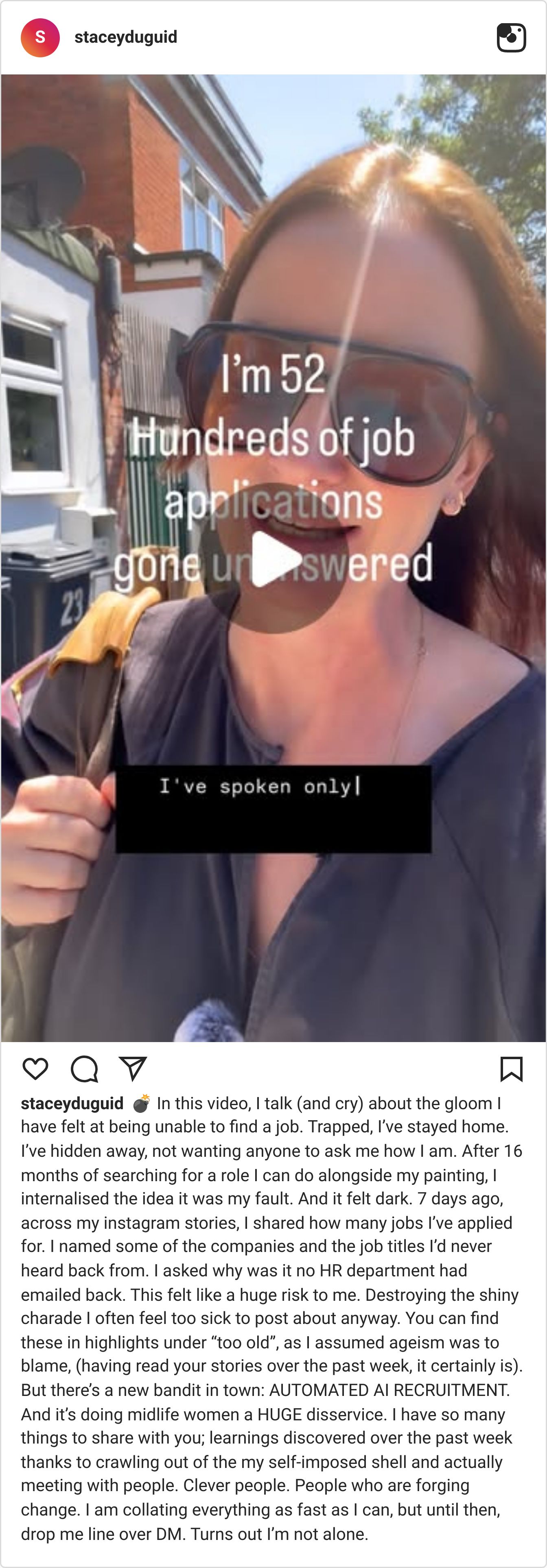
Not a nobody. Ten years as Executive Fashion Editor at Elle UK, recruited personally by the editor after they met at a Prada event.
Before that, stints at Paul Smith, Giorgio Armani, and Prada itself. After Elle, she went on to become fashion editorial director at Harrods. Bylines in British Vogue and the Sunday Times. This is about as dazzling a CV as it gets.

Accomplished. Ambitious. And still, the current job market has made it almost impossible for her to find work.
She's reportedly having to draw on part of her own pension just to get by and is currently on benefits.
Stacey isn't as different from the rest of us as that CV might suggest.
She's a single mum, with no second income sitting quietly behind her while she figured it out.
Here's the thing that gets me most about her story: she did not sit around waiting for the perfect director level role to reappear. She applied for EVERYTHING. Big brand jobs. Small brand jobs. Part time warehouse work. She even tried for a shelf stacking shift at Tesco. Over a hundred applications and not one interview.
A friend, trying to help, suggested the now standard bit of midlife career advice: delete 15 years off your CV. Take off the graduation date. Make yourself look younger on paper so you get further than the first filter. Yikes.
For a long time she did what a lot of us would do with something this humiliating: she hid it. Stayed home. Avoided the question "how are you?" because she couldn't face answering it honestly. She kept up what she's since called the shiny charade, while privately convincing herself the whole mess was somehow her own fault.
Then she started posting the receipts. Which companies. Which job titles. How many times HR never replied at all. She's since filed it all under a highlights folder on her Instagram simply titled "too old." Putting a name to something she assumed was ageism felt like the biggest risk she'd taken in months. Turns out it was the thing that cracked the whole thing open.
Thousands of women her age replied with some version of the same thing: this is me too. It went so far she ended up on the cover of The Times, opposite a piece on the Prime Minister.
And here's the twist she didn't expect. It's not just ageism in the traditional sense. Somewhere in the mix is a newer, quieter problem: automated AI recruitment systems, filtering women like her out long before a human ever opens the CV.
Stacey didn't just vent and move on. She's now out meeting people genuinely clever people, she says, already working on fixing this collating everything she's learning so she can bring it back to the thousands of women who DM'd her to say they're not okay either. She's also launched a petition and a platform called The Encore, pushing the government to actually regulate AI in recruitment.
Read more on this story via The Times' "The Story" podcast, where journalist Claire Cohen covers it in full.
Herbold30s Top Recruitment Tips
Stacey's story got me thinking about you guys. Some of you are desperate to leave your job but can't even get past the application stage. Here are a few things worth trying if you're job hunting right now (please share this bit with anyone who needs it):
Mirror the job description's exact language. Most applications are read by an Applicant Tracking System before any human sees them. If the posting says "stakeholder management," don't write "worked across departments" instead use their words.
Keep formatting boring on purpose. No tables, text boxes, columns, or graphics. Some ATS systems can't parse them, and your CV gets dropped without anyone knowing.
List employment dates clearly, not buried in small print. Hiding dates to dodge age bias sometimes backfires as recruiters notice the gap and assume the worst anyway.
After every application, follow up. Send the recruiter a short email letting them know you've applied, and send them a LinkedIn connection request or message too. Two touchpoints instead of one CV disappearing into a portal.
Use your network before HR ever sees your name. If you know anyone at the company, ask them to flag your application directly to their HR team or hiring manager. A personal vouch from an internal contact carries far more weight than any algorithm.
Build a bit of a presence on LinkedIn. Start sharing content related to your field — a comment on industry news, a short post about something you're working on. It keeps you visible and gives anyone checking you out something more current than a CV to go on.
Track what you're sending. Company, role, date, contact. If nothing's landing after 15–20 tailored applications, it's worth reviewing the CV itself rather than assuming it's just bad luck.
That's it for this week folks. If any of this hit close to home, you are nowhere near as alone in it as it feels. PS: if you've navigated a midlife job search recently brutal, brilliant, or somewhere in between hit reply, I'd love to hear it. 🖤
Are you enjoying this newsletter?
Help us spread the word and share with your bestest girlfriends. They need this too!
See you next week!
What do you think about this newsletter?
DISCLAIMER: None of this is financial or legal advice and we are not certified financial advisers or lawyers! This newsletter is strictly educational. Please consult with an independent financial advisor or lawyer for advice on your specific circumstances.
